


The Art of Sorting: How Children Playfully Grasp the World
In a nutshell
- Sorting may look like a game, but it is a highly complex cognitive achievement.
- Children learn to recognize patterns, form categories, and understand basic logic.
- It trains analytical thinking, visual perception, logical reasoning, and problem-solving.
- This can be encouraged incidentally: color safari, sock matching, sorting fruit.
It's an afternoon like many others. The sun shines warmly through the windows; building blocks of all colors and shapes are scattered on the carpet.
My little niece sits in the middle – highly focused, her brow slightly furrowed. In her small hand, she holds a red cube. She slowly turns it, examines it carefully, before finally placing it with the other red blocks. Then she reaches for a blue triangle. I watch her quietly and fascinated – and I see it clearly: Something wonderful is happening here. She is sorting. And this seemingly simple act has incredible significance for her development.
Why Sorting is So Much More Than Just tidying Up
What at first glance looks like a game is, in reality, a highly complex cognitive achievement. When sorting, children learn to recognize differences and commonalities. They begin to discover patterns, form categories, and understand the first rules of logic.
It is a small step for a child – and a giant leap for their mental development. Sorting trains:
- Analytical thinking
- Visual perception
- Logical reasoning
- Problem-solving skills
With every building block sorted, not only does the tower in front of them grow – but also their ability to understand the world around them a little better.
Sorting in Everyday Life: How We Incidentally Encourage Children
What touched me so much when observing my niece: Sorting happens quite intuitively when children are given the opportunity. And we adults can easily support this urge to explore – right in everyday life:
- 🌈 Color Safari: Stroll through the living room together and collect everything that has a certain color. Who can find the most yellow?
- 🧦 Sock Matching: Let them help with folding laundry – finding sock pairs, sorting by size or pattern. A wonderful exercise for fine motor skills and cognition.
- 🍎 Fruit Architecture: Sort fruit types while shopping or cooking. Or set up a small "market stall" at home and let them arrange apples, pears, and bananas.
By the way: Sorting and grasping go hand in hand – you can read how to strengthen fine motor skills incidentally in Promoting Fine Motor Skills: 12 Exercises for Small Hands.
Made for Sorting
Some of our products are perfect for sorting and assigning:
- Jolly Pockets: Our Jolly Pockets are predominantly about sorting and matching – ideal for practicing categories and order in a playful way.
- Colorful Caterpillar (from 18 months): Colors, shapes, and animal tails to match, plus small puzzles – a true sorting paradise on six pages.
- My First Bicycle (from 18 months): Here, your child assigns cute animal finger puppets to their favorite food – matching in the most beautiful little role-play.
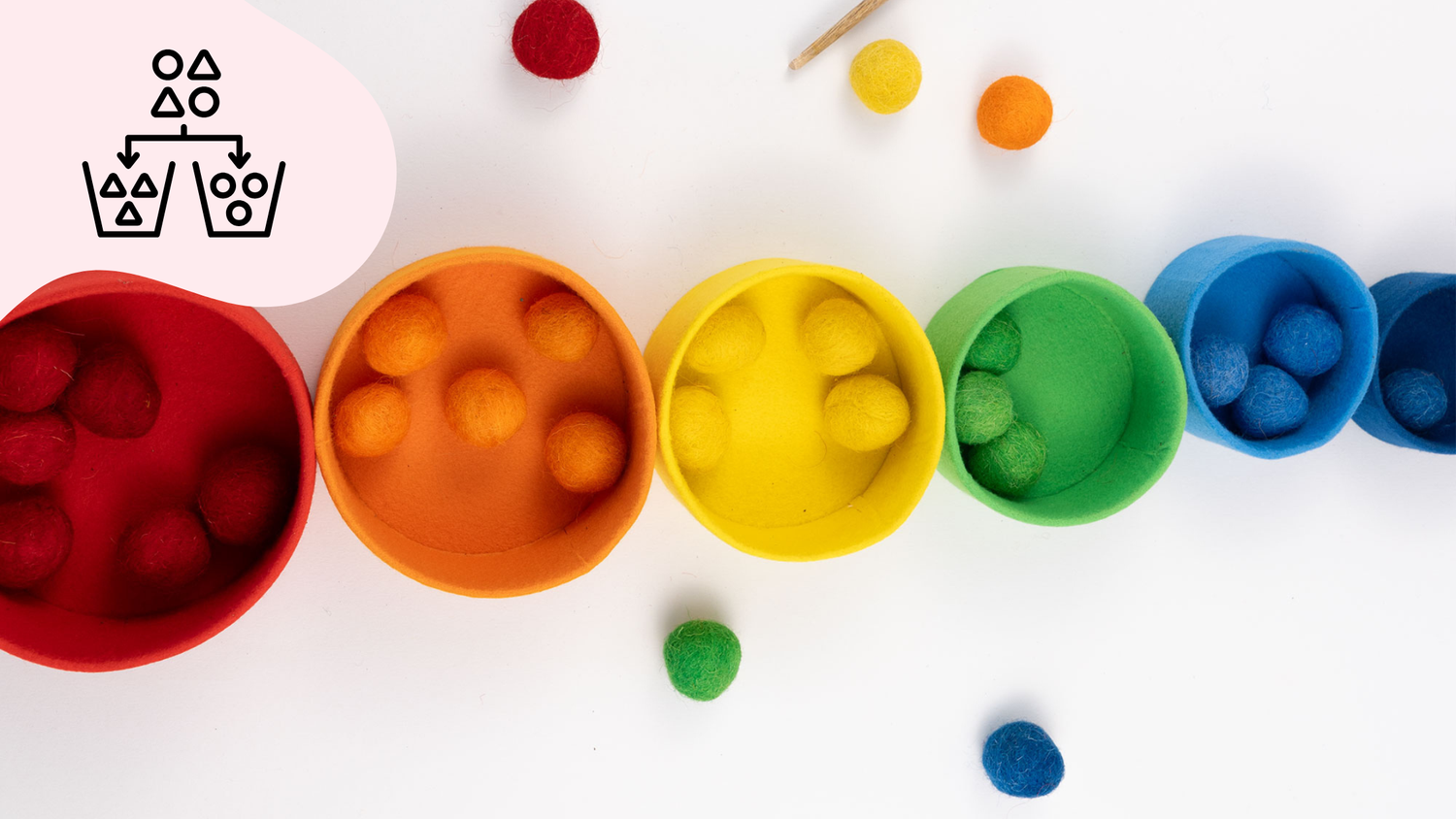
- Kullerbunt Stacking Tower: The colorful felt balls are assigned to the matching colored cups – sorting colors and stacking in one, wonderful for the youngest.
This makes learning an adventure – and promoting sorting skills incidentally becomes a favorite game.

Leave a comment
All comments are moderated before being published.
This site is protected by hCaptcha and the hCaptcha Privacy Policy and Terms of Service apply.