



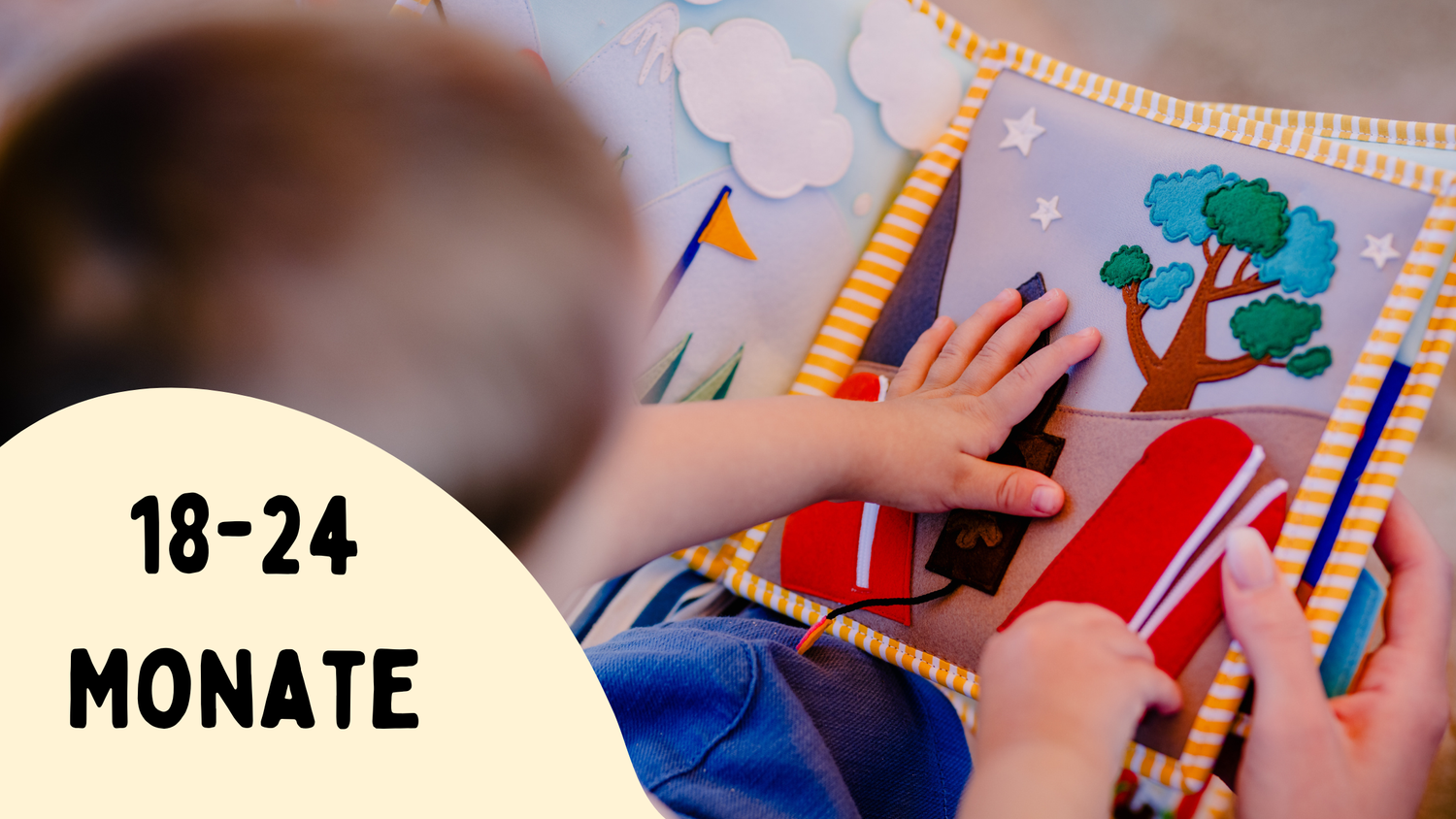
Child Development 18–24 Months: Deepening Independence, Thinking & Play
In short
- The desire for independence grows stronger: "I want to do it myself!" is the motto.
- Children plan small steps ahead, solve initial problems, and show more persistence.
- Colors, shapes, and simple quantities are recognized; imagination blossoms.
- It is precisely now that the autonomy phase (tantrum phase) often begins – a good sign.
Between 18 and 24 months, children develop noticeably – physically, mentally, and emotionally. The desire for independence grows stronger, processes are to be understood, and things are deliberately tried out. Children begin to make connections, solve simple problems, and create their own small play worlds.
In this phase, calm, varied play impulses foster your child's development by playfully combining fine motor skills, concentration, logical thinking, and imagination.
What happens between 18 and 24 months?
Children at this age combine thinking and acting more purposefully. They plan small steps ahead, try out solutions, and show significantly more persistence in play.
Typical developmental steps in this phase are:
- more targeted stacking, sorting, and matching
- opening, closing, buttoning, and pulling with more control
- recognizing colors, shapes, and simple quantities
- understanding initial logical connections
- longer, concentrated play phases
- increasing imagination and independent storytelling
Fine motor skills, problem-solving abilities, and concentration now develop hand in hand. At the same time, the joy of doing something "right" oneself grows.
By the way: With a strong will often come strong emotions. If your child has tantrums more frequently now, this is not a setback, but development – you can read how to lovingly support them in Guiding through tantrums.
How educational toys meaningfully support development
Educational toys can now become more diverse and combine different play ideas. A clear structure that offers orientation yet allows for free play remains important.
Meaningfully designed educational toys support:
- Fine motor skills and dexterity
- Concentration and perseverance
- Logical thinking and initial problem-solving
- Creativity and imagination
- Independent play
Play offers that enable both targeted tasks and free exploration are particularly valuable.
Recommendation for 18–24 months: Mini Quiet Book "Sonnenschein"
The Mini Quiet Book "Sonnenschein" (Sunshine) brings colors, shapes, and small everyday adventures into the hands of curious children. With a cheerful sun, rainbow, and loving details, it invites discovery, sorting, and trying things out.
Each page opens up a new play idea – from counting and simple logic exercises to fishing in the sea and picking fruit from the tree. Playfully, it supports:
- Fine motor skills and hand-eye coordination
- Building concentration and perseverance
- Supporting initial logical thinking and problem-solving
- Stimulating imagination and independent storytelling
Handcrafted from robust, OEKO-TEX®-certified materials, it is durable, soft, and child-safe. Compact, colorful, and versatile, it accompanies children in everyday life – at home and on the go. Not without reason, it is one of our bestsellers.
Simple play ideas for 18–24 months
1. Sorting & Matching. Colors, shapes, or elements are sorted and matched together. Fosters: Logical thinking, concentration, fine motor skills. To understand why this has such a big impact, read The Art of Sorting.
2. Small thinking tasks. "Where does this belong?" or "What comes next?" – your child tries out solutions and repeats them. Fosters: Problem-solving ability, patience, self-confidence.
3. Inventing own stories. Figures and scenes in the book are used to tell small stories or reenact them. Fosters: Imagination, language, creative thinking.
The most important thing at the end
In this phase, the desire to understand things and create them independently grows. Varied play offers strengthen confidence in one's own abilities and promote sustainable learning.
And if something doesn't work right away: Give your child a moment before you help. It is in this moment that the most important thing happens.
Back to Child Development 12–18 Months · Next to Child Development 24–36 Months

Leave a comment
All comments are moderated before being published.
This site is protected by hCaptcha and the hCaptcha Privacy Policy and Terms of Service apply.